
[Warning: leave this post if it shakes your faith, or empty your glass to receive the pouring of this post. Besides, this post is very long. This post was translated from Indonesia language with the help of google translator, and rough editing].
A Facebook friend of mine [Jesus Anam] said, “Islam is (is a religion) rahmatan lil alamin”. Who said that? Was the prophet called Muhammad? Based on modern history (historiography) that I studied, the figure of Muhammad 570-632 AD did not exist. Please, protest! What I say is not based on an internal tales that have been widely circulated, even shared by non-Muslims. I am not a religious person with a faith that adheres to popular and well-known folk tales.
One day, around 2018, my friend, a fellow murshid, told me that during the period of leaving Islam in the 2016, he doubted the figure of Imam Mahdi who had been indoctrinated to him all this time. [Shia version of Imam Mahdi 12 Ushulli]. Then, he put his trust and asked him in his deep contemplation who he really was, then he told our murshid. I was moved by my friend’s story.
So, in my tawasul, I asked the Rasulullah Muhammad too, “Who are you, really?” However, I advise you not to use this method if you are not trained with the skills of a historian-anthropologist. In every doubt I had, I listened to His responds, that He did not matter if mankind already believed in the version 570-632 AD, because that is not what really important for a person in living as a human.
I confided to him that so many people left Islam because the Neo-Islamic and Pseudo-Islamic version of the imperialist-consensus version of Islam had become so popular and oppressed their lives. So many things from that version of Islam are so foolish, ridiculous, evil, and do not really make sense. It is doubtful and deserves to be laughed at, if not being mocked. Especially what I talked about at that time was about the hijab.
One of the first things He directed me to do was to open a chapter in the Gospel of Revelation (in Buyruk Alfurqan or The Beloved and I: New Jubilees Version), which led me to the Ridda War. Before discussing the Ridda War, I will discuss why the Muhammads were condensed into just one figure in 570-632 AD.
The date was chosen by early Islamic historians such as Ibn Ishak under the patronage of the new Abbasid regime and required a strong political identity. Ibn Ishak, for example, was a contemporary of Sayyidina Jafar Sadik [d.765 AD], who conveyed transmissions in secret to his disciples and some of them experienced persecution from the Abbasid regime. In fact, Sayyidina Jafar Sadik himself was poisoned to martyrdom on the order of the caliph Al-Mansur, the sponsor or patron of Ibn Ishak.
Of course I don’t know the exact reason why the figures of the Muhammads were condensed into one figure 570-632 AD, but through that date, I can make a number of historical hyphotesis, besides the interest of the new Abbasid dynasty in “canonizing” the legendary figure named Muhammad into one. private 570-632 AD only.
Some of the possible reasons are as follows.
First, it relates to the history of the Byzantine Roman and Sassan Persian proxies. In the years of Muhammad’s birth, between 570-571 AD, an important event occurred, namely the defeat of the Ghassan confederation over the Lakhmid confederation. Not long after, the first Byzantine-Sassan War took place which ended in 591 AS, just as we find the story of the young Muhammad known by the so-called Quraysh. Who are the real Quraysh? Is this name known in Roman and Persian records? The only known ones appear to be the Ghassan confederation and the Lakhmid confederation.
Second, the year of his death (632 AD) is two years around the defeat of the Persians from the Romans, and since then there have been a number of persecutions and repressions of Jews who are considered to support Persia, including forcing a number of elites and leaders to convert to Christianity (Western). Meanwhile, in Persia there were fights for the throne between the two clans and a civil war, right during the reigns of two female emperors. So, there are enough reasons to say that the victory of the caliph Umar over Ctesiphon (the capital of Persia), and Jerusalem, in the years 634-637 AD was partly due to these factors.
Third, in those years, despite the second Byzantine-Sassan War, there was no longer powerful Ghassan or Lakhmid confederate. In other words, in the Arabian territory that was as wide as from the Decapolis, Nabatea, to the Hejaz and borders with Yemen (Himyar), Egypt, and Ethiopia (Aksum), there were no strong confederate powers like Ghassan who supported the Roman and Lakhmid who supported Persia.
It’s just very few reasons, for the time being.
However, with “the period of emptiness” and “the period of internal turmoil in Persia” and
“The period of Heraclius’ oppression”, then giving rise to the figure of a great hero for a society in a region that shares traditions, cultures, language families, etc., which for centuries have been the object of contention between Romans and Persians, was of course something that is timely and appropriately needed. The Abbasids who stood on the ruins of Persia needed it more than the Umayyads who stood on the ruins of the Decapolis which had been in centuries living in Hellenist culture.
So, yes, of course the early Muslims, who are described as companions of Muhammad 570-632 AD were the real pioneers in a movement that could be called a post-Ghassan and post-Lakhmid nationalist movement. The so-called Quraish was a confederation of various tribes, which led the movement, although at first the confederation was divided, just as in Indonesia there was PDIP which supported Ganjar Pranowo and another supported Puan Maharani. In this case, there was a stronghold of the Quraysh party that supported Muawiyah, and there was a stronghold of the party that supported Sayyidina Ali ibn Abi Talib.
Readers who are accustomed to following my writings may already have guessed that I will refer to any of the characters of Muhammad condensed into one figure 570-632 AD.
However, what I want to emphasize in this article is that the “crimes of the Islamic religion” occurred not because Muhammad 570-632 AD appeared in history carrying a sword to conquer the world, because the 570-632 AD figure was as fictional as Jesus Christ. 33 AD. How can a fictional character like Voldemort be cursed for his crimes?
The Quraysh confederation along with other confederations that later founded the Umayyad dynasty in one of the Decapolis cities was a complex group of people: in general they were Israelites, and/or Peranakan Jews, and others were Arabs. Their religions are also actually diverse, not mere “paganism” as the Orientalist mindset is still influenced by the Western Church’s thinking about what is called religion. This mindset permeated the mindset of Jews today, and then Muslims today, because the Romans colonized them for a long time.
I started to get used to distinguishing myself between “Israel” and “Jews” even though the two were “interchangeable”, because there were immigrants from the Kingdom of North Israel which was subjugated by Neo-Assyrians, and there were immigrants from the Kingdom of Judah which was colonized by Babylon and Persia, then they were all mingled and got married with each other .
It was the immigrants in the Decapolis, Nabatea, and other Arabian regions who were the ancestors of the clans in the Quraysh confederation. They are in the Ghassan confederation which sided with the Romans as well as in the Lakhmid confederation which sided with the Persians, there were those who embraced Oriental Christianity like their brethren in Yemen and Ethiopia, and there were also those who embraced Judaism (Oriental too, as in Yemen and Ethiopia). Meanwhile, those who live in oases (deserts) and not in cities and not in ports, aka in the interior, which are commonly called Bedouin Arabs, some have also embraced Oriental Christianity.
The nationalists were very tired of fighting between the two superpowers, first the Greeks then later then Romans, and then the Persians who was still quite mighty until around 630 AD because of the wars between themselves. Their tiredness must also be understood: because most of them were merchants who used to pass through conflicting areas and bring products imported from far away, even from the area we now call Indonesia.
All the tales in the hadiths about wars are actually closely related to the two Byzantine-Sassan wars I mentioned, the Persian internal wars, and the second proxy wars in Yemen involving Ethiopia. Likewise the story of the migration in two waves. Isn’t the more popular and the more liked the tale, the more it will be considered as truth, especially if it is conveyed by the authorities? Who believes that the people of Wadas (in Central Java) are against mining and not dams, and who believes in buzzers and gimmicks “sacrificing for dams for the common good”?
The dispute between Sayyidina Ali’s family and factions supporting Sayyidina Ali versus opponents of Sayyidina Ali’s factions is not as simple as the “Islamic internal religious schism” such as the tales of the rivalry between Sunnis and Shiites and the discussion of the Mutazilah, Khawarij, and various schisms in Islamic history. My historical instinct is no longer able to digest it as simple as the commoners, mediocres, or simplistic people who read it (or who wants it?) as mere religious-spiritual tales.
The date 632 AD was also deliberately chosen because of the Ridda War which took place in 632 AD. Almost all Muslims view it as a war against those who apostatized or left Islam and those who were called false prophets such as Musailamah and Sajjah. Before discussing the context of the incident, I will give a little hint about the meaning of the words “ridda” and “apostate”, from the Hebrew lexicon, and not from the Arabic lexicon which has been mixed with post-Abbasid meanings.
1. The word ridda comes from the Hebrew, Aramaic, ancient Arabic, Syriac, Akkadian, Geetz, etc., (no.7287, 7287b) which is radah which means to dominate, to rule, and to scrape out. In other words, politically the Ridda War meant a war to dominate and suppress the enemy.
2. The word ridda which later developed into apostasy [irtidad] also comes from the word radad (no.7286) which is to beat down.
3. When developed into apostasy, it is also processed from the words “marad” (no.4775) and “mered” (no.4776), namely to to rebel, and suc
4. The words in marad and mered are also related to the word “meri” (no.4805) which means rebellion, and the word “marah” (no.4784) which means rebellious.
5. Meanwhile, the word “marah” (no.4751) which means bitterness is related to the name of the bitter water in the Sinai Story, and “Marah” (no.4785), which is absorbed in Malay for emotions that match covering bitterness, angry, and wrath.
The Ridda war was not about leaving Islam and false prophets, but wars against those who left the Quraysh confederation’s agreement after the first leader of their confederation died. It was the leader who was later named and also known as Muhammad. Musailamah, whose real name was Muslimah, rejected the new agreement that chose Abu Bakr as caliph by eliminating autonomy for the madina or other harams, including the Yamamah he led. A number of clans allied with Muslimah supported the Yamamah confederation’s dispute.
The Garden of Death which took place in Yamamah as the culmination of the Ridda War, had slained Muslimah, and was a repeat tragedy of the events that took place in Jerusalem during the life of the “real Jesus Christ”, namely the Events of 66-70 AD. For those who study the events of the revolution, they will remember when the revolution against the Romans splitted between Simon bar Giora and John of Giscala. This is what was discussed in the Revelation, according to Buyruk Alfurqan, which views the texts not in preterism, but in historicism. As in the Bektashiya tradition, it is believed that there is a “repeating historical pattern” and therefore the Revelation contains not only historical experiences, but also prophecies of the recurrence of that experiences.
The first leader of the confederation, which we know as Quraish, led the confederacy in Yathrib which would later be known as “Medina”, even though there were a number of madina, haram, or cities with Arab-Jewish traditions which were also inhabited by many Oriental Christians such as in Yamamah. Muslimah joined in alliance with him because there was no longer the power of Lakhmid, and Muslimah of course also did not want to be straddled by the Romans. The previous leaders of Yamamah tended to support the Lakhmid and the Persian, rather than the Ghassan and the Roman.
The first leader was the son of one of the elites of the previous confederation, the Ghassan confederacy, whose stories are actually also widely referred into the story of Muhammad 570-632 AD. So, I therefore say there were several Muhammads before Muhammad who was actually referred to as prophes and apostle in Muslims’ shalawats. He was the transmitter murshid who collected all written and oral transmissions, and received revelations to respond to all these transmissions in order to guide his muhibs and murids in the situation of the 7th century AD at that time. The muhib and murids referred to the book as the Quran, namely readings to be recited, because it is actually hymn to be sung.
In 692 AD, after Al-Hajjaj succeeded in controlling the haram of Mecca and killing the rival caliph of his caliph, Abdul Malik I, he had the idea to canonize the texts owned by Muhammad’s disciples for their new national identity, as well as to restore the image of the Umayyad dynasty because in 680 AD they had massacred the families of Muhammad and Ali in Karbala. Inspired by Christianity which canonized the Gospels, Al-Hajjaj also took the initiative with the book to popularize the unified language of one of the lingua franca at that time, a creole Arabic dialect at that time in the Decapolis.
If we want to say “the first crime of Islam” then it is the success of the caliphate under Umar ibn Khattab in usurping the Persian superpower. Then, about two decades later Muawiyah built the capital in Damascus which was Hellenicized since Greek times fluttered with the emperor Alexander. Then it’s complete! The Caliphate with an Islamic identity became the main rival of the Romans who had succeeded in overthrowing Greece several decades before the revolutionaries created the figure of Jesus Christ 0-33 AD.
If you are still a Christian or a Jew, you should look in the mirror before laughing at the “crimes of Islam” and laughing at the figure of Muhammad 570-632 AD. However, I can forgive you if you are ahistorical, especially if it is anachronistic.
However, this movement emerged under the name “Islam” and the figure was popularized under the name “Muhammad” because of the things contained in the traditions of Christianity and Judaism that were embraced by the pioneers of the movement itself. Not from the void of the desert. Except for those of you who are blind, who do not know where the Decapolis, Nabataeans, the Al-Jawf site, the ancient city of Dumah which is mentioned in the Old Testament, the old port city of Aden mentioned in Ezekiel, etc.thinking Arabia was just barren lands without city and civilization at all.
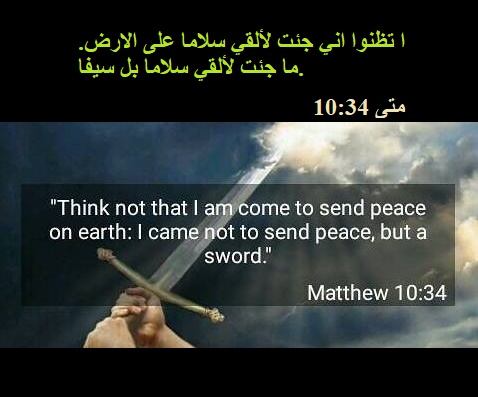
Among them, Matthew narrates Jesus’ saying, “I do not come with islam, but with a sword”, and Oriental Christians have put their faith in Jesus Christ under the name “Muhammad” in their prayers in the 7th century AD. Meanwhile, Heraclius had became more oppressive towards the Jews in his area because they sympathized and even followed this nationalist movement, while other Jewish elites joined the Persian rulers fighting each other, reminding them more and more of the voices of Isaiah and Jeremiah when they cried “no Islam,” which was echoed again by their transmitter murshid in 612-622 AD.
Hallelujah! Hosanna! Hosanna!
Of course, for these “crimes”, the Umayyads and Abbasids needed to popularize the doctrine “Islam is the religion of rahmatan lil alamin.” Ever heard of Pax Romana? Don’t you miss a peaceful Indonesia, gemah ripah loh jinawi, in political stability?
When I give chronological year marks such as Muhammad 570-632 AD and Jesus Christ 0-33 AD, that means I am not generalizing like the attitude of some atheists and agnostics who say Jesus is a mere mythological story, and so does Muhammad (which surprisingly many actually believed in one figure in those years). Of course, there are historical figures behind the two characters.
In the sampradaya tradition, “Islam is rahmatan lil alamin” is teaching a person to livecompletely as human being, and not an expansionist, Manifest Destiny, and destructive people. Murtad is an attitude of defiance or rebellion from a murid or muhib against his/her murshid – who was often also a prophet or apostle – that is, doing destructive things against the teachings and wisdom of the master. Likewise, the kafir, which is simply the attitude of muhib, murids, and those who listen to the advice and teachings of a sage, but veiled themselves from the truth they have received, that they continue to do destructive things.
When a sampradaya tradition that became a revolutionary movement such as in 6-70 AD, and then in 612-632 AD, was then taken over by a narrow nationalist ijtihad, then we find a change in the meaning of murtad, kafir, and heresy. To cover up what actually happened in the Ridda War, and the resistance of the revolutionary Sufi murshids, what was highlighted were the stories of their disobedience in faith.
We hear, for example, the stories of Al-Hallaj, Sayyid Nessimi, Hamzah Fansuri, and Sheikh Siti Jenar which impress them as defiance in terms of creed and religion. Likewise, there were many baba and dede as well as Sufi kalandar before the founding of the Ottomans until the end of the Ottomans who resisted and were executed or persecuted on charges of apostasy, infidelity, and or heresy. In fact, their movement and/or resistance is a social movement or a revolution to oppose policies that are corrupted, destructive, tyrannical, discriminatory, and even harmful to the people (and nature) where they live.
Their stories are often imbued with spiritual romance, because the leaders of the movement were indeed a waliullah, saint, or a murshid who presented himself on the altars of life for humanity until finally martyred. In the same context, stories about the Prophet Muhammad 570-632 AD are filled with spiritual romanticism and religious glorification, as the story of Jesus Christ 0-33 AD, to be later used and exploited for political interests and “new nationalism” from the “Israeli nation” while they lived in colonization and diaspora.
By “Israelites” I mean all those who believed in and/or received the transmission of the story of Sinai, at any level. Both the Bible and the Quran repeat the story of Sinai and respond to all the problems of the disciples and the muhib, often through the story of Sinai. After the failed “Jews” as the fall of the Maccabees and the failure of the Siege of Jerusalem in AD 70, the Roman empire usurped the identity of the revolutionary movement Jesus Christ for Christianity created (which I call Neo-Christian).
Likewise in the time of Abdul Malik I, he did it together with Al-Hajjaj after all was completed: the conquest of Jerusalem, and the destruction of the Persian power, then half of Ali’s family and faction was successfully genocidated, then the cities of Mecca and Yathrib were conquered, and finally Muhammad was willing to compromise so that canonization of the Quran can be done. Abdul Malik I’s work was complemented by the success of the Neo-Umayyads in Iberia, then since 750 AD was established by the Abbasids who succeeded in silencing Ali’s disciples and muhibs with divide et impera, and finally perfected by the Ottomans who succeeded in overthrowing the Romans for good.
I don’t want to explain in my posts on social media the details of the Muhammads who transmitted the divine revelations they received, and likewise the one Muhammad who established the Quran (before canonization). Please wait for the book I’m working on. May Allah with the prayers of the transmitter murshids of the ancestral allow! Whatever it is, well-known expressions, including terms according to the sampradaya tradition and according to the imperial consensus tradition (Neo-Islam and Pseudo-Islam), are of course very different, even very inconsequential according to the sampradaya tradition.
Thus, the phrase “Islam is the religion of rahmatan lil alamin” also remains as a slogan of “Pax Islamica” like all the slogans and gimmicks of the greedy imperialists and oligarchs, but dressed as angels with all the philanthropic assistance and generous sponsors.
(We see it in similar cases in Indonesia, such as the Wadas case. When some of you see the Wadas people reject dams and are required to sacrifice as a form of their nationalism. Are dams really necessary and the best solution for agricultural irrigation, and or is it just an evil plot for andesit mines, which is a way for structural impoverishment? Capitalism is of course the new religion of most of us who are more busy talking about the discourses of tolerance and diversity as well as “evil religions” such as Islam).
According to the historical pattern, to end all the damage and destruction, after repeated life to give every soul a chance, we shall wait when the boil gets bigger, only then it will explode. So, it has been more than 2000 years for the whole nation of Israel (by my definition previously), and it might explode in the near future, to be finished once and for all. Even if it is not in the near future, since it has already been 100 times of opportunity, it would not be long before there are seven more chances of being reborn.
Rahayu Sabbath. May the guidance of Enoch, Eliyahu, Jesus, and Al-Mahdi in our every thought and action. Amen, amen, amen.
Siddhamastu,
Sheikha Hefzibah RA Gayatri Wedotami Muthari.
#Nafsiology
Bogor, 19 February 2021, originally posted on my Facebook pages, in Indonesian language.

